
The choice of a hedge trimmer depends on three technical parameters that most guides overlook: the compatibility of the battery platform, the ratio of tooth spacing to the actual diameter of the branches, and the type of transmission (brushed or brushless motor). We start from these criteria to establish a selection framework that holds up in the field.
Brushless motor and battery platform: the real technical criterion for hedge trimmers in 2026
The distinction between corded/battery/thermal remains useful, but it masks a more structuring choice. Today, the 18 V or 36 V platforms common to a whole range of tools (lawnmower, string trimmer, chainsaw, hedge trimmer) become the primary purchasing filter for those who already own motorized garden equipment. Staying within the same ecosystem reduces the number of batteries and chargers, thus lowering overall costs and clutter.
Brushless motors, now widespread in the mid-range from Ryobi or Einhell, significantly extend runtime compared to brushed motors. On a long hedge, this difference translates into the ability to finish the job on a single charge, whereas a brushed motor requires a recharge break.
The fast chargers available on these platforms allow you to recharge an 18 V pack in about 60 minutes, which is acceptable if you have two batteries rotating. We recommend checking the exact compatibility of the charger with the supplied pack: some entry-level models come with a standard charger, not the fast one. A detailed comparison of the available models can be found on taille-haie-warrior.com, which simplifies sorting between platforms and price ranges.
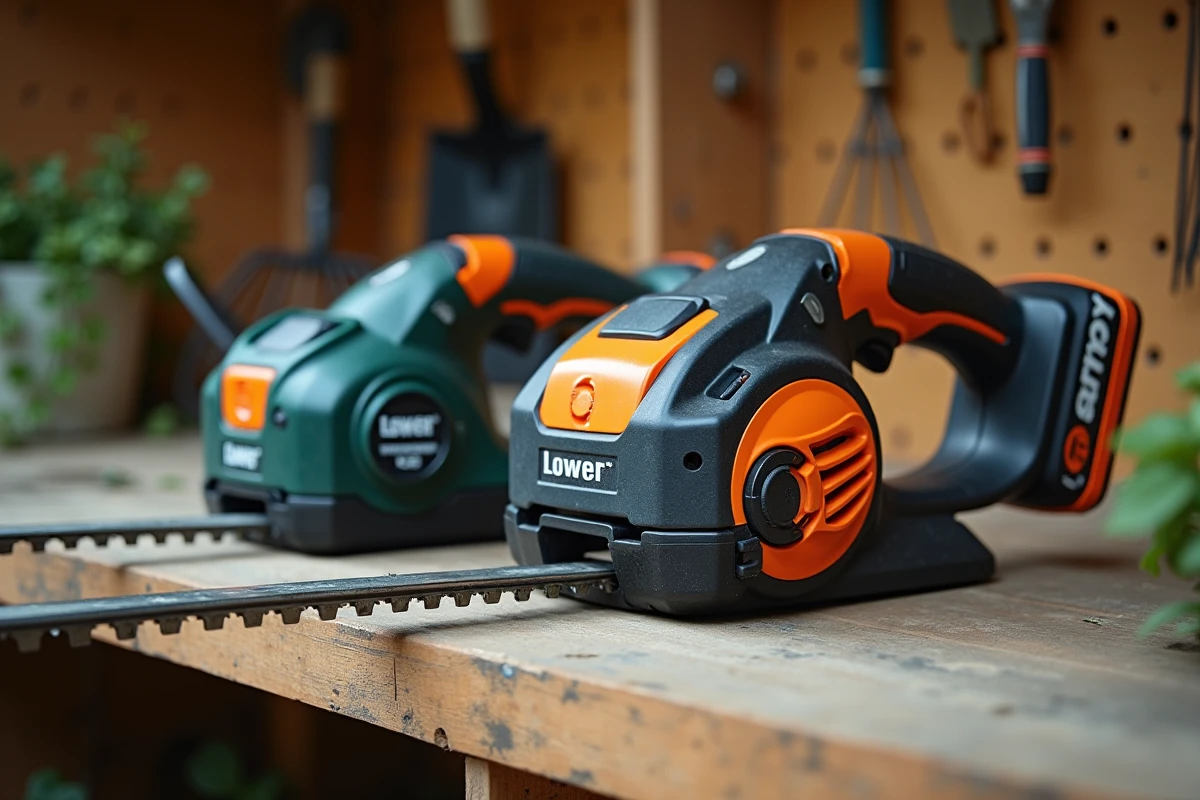
Tooth spacing and cutting diameter: sizing the hedge trimmer to your hedge
The spacing of the blade teeth determines the maximum branch diameter that the device can cut cleanly. Too narrow a spacing on thick branches causes clogging, bark tearing, and premature blade wear. Oversized spacing on a fine hedge allows shoots to slip between the teeth without being cut.
In practice, we observe three common levels:
- Narrow spacing (less than 20 mm): suitable for boxwood hedges, young privets, and topiaries, where the branches remain thin and cutting precision is paramount.
- Medium spacing (around 25 mm): versatile for the majority of regularly maintained hedges, laurel, hornbeam, photinia, with moderately sized branches.
- Wide spacing (30 mm and more): reserved for country hedges, old thujas, and restructuring cuts on semi-hardwood.
Choose the spacing based on the actual diameter of the branches, not just the species. A laurel trimmed twice a year produces much finer shoots than a laurel left free for three seasons. Before purchasing, measure a few representative branches on your hedge with a caliper or a simple tape measure.
Blade length and weight: balancing efficiency and muscle fatigue
The blade length directly affects the speed of progress along the hedge. A longer blade covers more surface area with each pass, but the weight increases and maneuverability decreases, especially in high positions or during vertical cuts.
For a modest-height hedge that you trim from the ground, a long blade speeds up the work without major drawbacks. Once the hedge exceeds shoulder height, the weight of the device becomes the limiting factor. Holding a heavy hedge trimmer with arms extended for several minutes generates fatigue that results in uneven cuts and an increased risk of musculoskeletal disorders in the wrists and shoulders.
The rotating handle (pivoting at 90° or multi-position) radically changes ergonomics for vertical trimming. It allows you to work on the side of the hedge without twisting the wrist. This is a criterion we place on par with the gross weight: a medium-weight device equipped with a pivoting handle tires less than a lighter model with a fixed handle.

Telescopic hedge trimmer or gas-powered: two distinct use cases
The telescopic hedge trimmer and the gas-powered model address different problems, and confusing them leads to a poor purchase.
The pole solves a reach problem. It allows you to reach the top of a tall hedge without a ladder, eliminating the risk of falling and speeding up the job. On the other hand, the pole moves the center of gravity away from the body, which requires shorter sessions and constant core engagement. On a low hedge, the pole is a hindrance.
The gas-powered model addresses a power and extended autonomy issue. It remains relevant for thick hedges in remote areas without electrical access, and for landscaping professionals who move from job to job. However, the noise, weight, and vibrations make the tool cumbersome for light maintenance trimming sessions.
A often overlooked point: regulations prohibit radical trimming between March and September in several European countries to protect nesting birds. Only light maintenance trimming is allowed in the absence of a nest. This regulatory framework guides the choice towards a quiet and maneuverable model for frequent refreshes during the season, rather than a noisy gas-powered model used twice a year.
- Battery pole: tall hedges, regular maintenance, solo work without a ladder.
- Gas-powered: thick hedges in remote terrain, intensive professional use.
- Standard battery (without pole): versatile for the majority of gardens, optimal weight/runtime/noise compromise.
The standard battery model without a pole covers the vast majority of domestic uses. We consider it the logical starting point, to which the pole or gas model is added only if the terrain configuration requires it. A thoughtful purchase based on tooth spacing, platform compatibility, and handle ergonomics will do more for cutting quality than an ill-calibrated power surplus.