The Velux roof windows manufactured before the year 2000 follow a different dimensional coding system than the one used today. Correctly identifying the dimensions of an old Velux determines the choice of replacement model, compatible blind, and installation method. Without this identification, the risk of purchasing a window unsuitable for the existing opening in the frame is real.
Coding of old Velux: understanding the system before 2001
Before 2001, Velux used a three-digit code to designate its models (for example GGL 1, GGL 4, GGL 9). This code corresponded to a specific size of glazing and frame but did not follow the current two-letter and two-digit nomenclature (CK02, MK04, SK06, etc.).
The transition from one system to another created a lasting area of confusion. An old Velux with the code “GGL 4” does not correspond to the same template as a current GGL MK04. To find useful information on SOS Urgence Dépannage, you must first locate the identification plate fixed to the window frame.
This plate, usually riveted in the upper part of the frame or on the right side of the frame, indicates the type of window (GGL, GGU, GPL) and its size code. On very old models, the plate may be oxidized or partially illegible, complicating identification.
Identification plate missing: measure the old Velux yourself

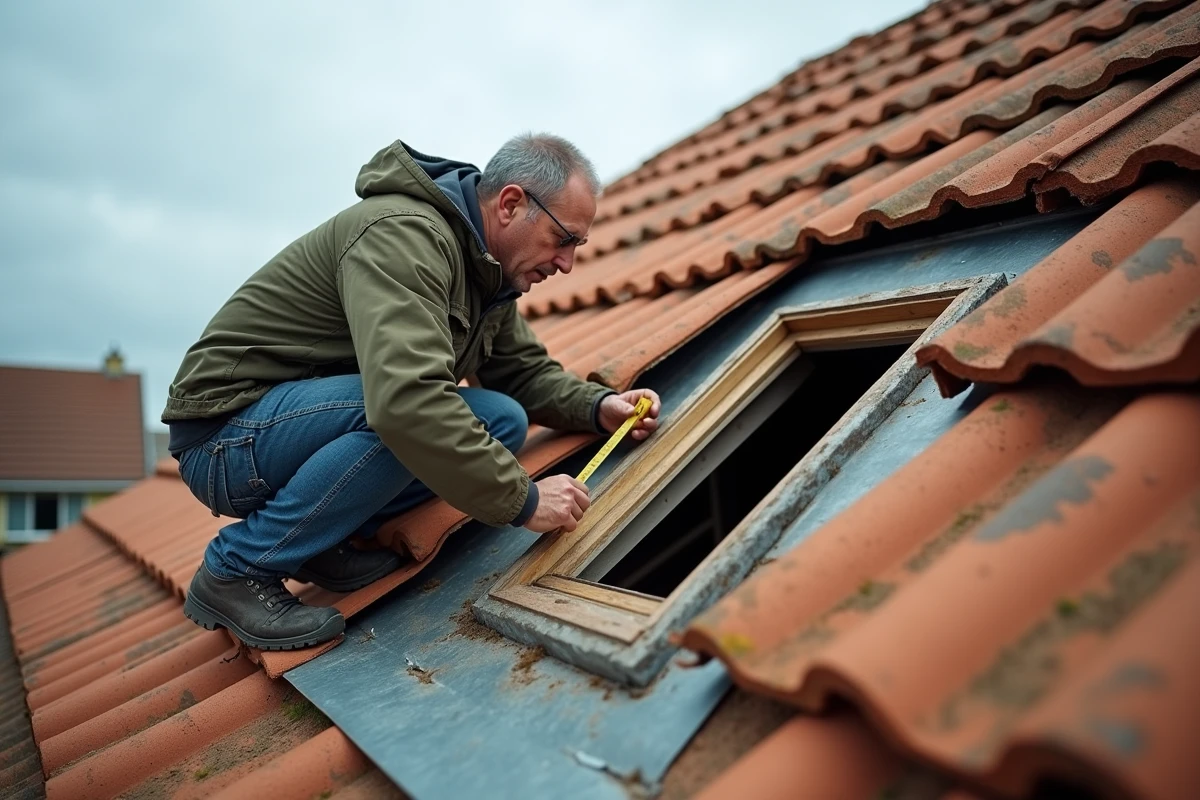
When the plate has disappeared or the inscriptions are erased, the only reliable method is to measure the frame from the inside. Two measurements are sufficient: the width and height of the frame (the fixed frame sealed in the structure), measured in millimeters.
The measurement is taken on the wood or PVC of the frame itself, not on the glazing or the interior cladding. The cladding (the decorative white or wood frame that surrounds the window on the room side) always exceeds the actual dimensions of the frame by several centimeters.
- Measure the width of the frame from one outer edge to the other, horizontally, at the center of the window.
- Measure the height of the frame from the top edge to the bottom edge, vertically, at the center as well.
- Note the two measurements in millimeters and compare them to the conversion tables between old and new Velux references.
A discrepancy of a few millimeters between the measured value and the theoretical value in the table is normal. However, a discrepancy greater than one centimeter often indicates a measurement point error or a model outside the standard catalog.
Conversion table for old and new Velux codes
The correspondence between old numeric codes and current letter codes follows a logic of increasing width then increasing height. Here are the most common equivalents for the GGL range:
| Old code | New code | Width x height frame (approx.) |
|---|---|---|
| GGL 1 | MK04 | 78 x 98 cm |
| GGL 4 | CK04 | 55 x 98 cm |
| GGL 6 | FK06 | 66 x 118 cm |
| GGL 9 | SK06 | 114 x 118 cm |
| GGL 10 | UK04 | 134 x 98 cm |
These correspondences cover the majority of Velux installed in French homes between the 1980s and 2000. For even older models (1970s), the dimensions may differ by a few millimeters from this table, as manufacturing tolerances have evolved.
Particular case of non-standard roof windows
Some old Velux have been installed with custom frames or structural adaptations that do not correspond to any catalog reference. In this case, replacement requires resizing the opening in the roof, with cutting or adding rafters. This type of intervention requires a qualified carpenter.
Replacing an old Velux: constraints related to RE2020
Since the gradual implementation of RE2020 starting in 2022, the replacement of old Velux in major renovations must meet thermal performance criteria. Design offices almost systematically require roof windows with Uw coefficients and solar factors Sw compatible with RE2020.
Old models left in place generally do not meet these thresholds. Adapting a blind or secondary glazing on an old Velux is not enough to achieve the required performance. Complete replacement, including the frame, remains the solution chosen by professionals.
Eligibility for MaPrimeRénov’ and CEE aids
To benefit from MaPrimeRénov’ or energy savings certificates when replacing a roof window, the installation must be carried out by an RGE installer. The new Velux must have a valid technical opinion and meet the Uw and Sw performance criteria defined by the scheme.
- The Uw coefficient (thermal transmission) of the new Velux must be below the maximum threshold set by the current scale.
- The solar factor Sw must be sufficiently high to ensure natural light intake without overheating.
- The invoice must mention the technical characteristics of the installed product and the RGE qualification number of the installer.
Several support platforms have reported since 2024 a significant increase in requests for the replacement of old Velux motivated by these financial aids.
Blinds and accessories: compatibility depends on the exact size code
A blackout blind or Velux roller shutter is manufactured for a specific size code. A blind designed for an MK04 does not fit on a CK04, even if the width difference seems small to the eye. The size code of the Velux determines the compatible blind, with no margin for tolerance.
For old models, you must first convert the numeric code to the current code using the conversion table, then order the blind in the current reference. “Universal” blinds sold in supermarkets do not guarantee light tightness or durability on an old Velux whose guide rail may have worn out.
The accumulation of small measurement errors, combined with a misunderstood coding, generates the majority of returns of incompatible blinds. Taking the measurements of the frame, identifying the original code, and then checking the correspondence remains the only reliable sequence before any order.