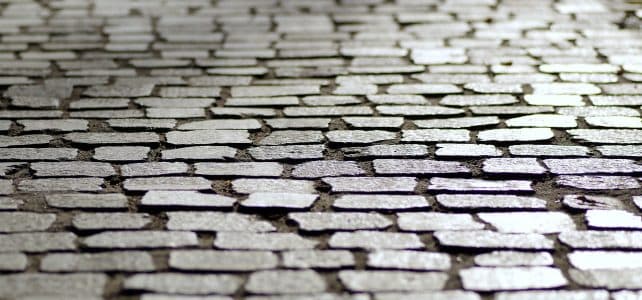
Driveway pavers are a wise choice for anyone looking to add an aesthetic and durable touch to their walkway or garage entrance. Their resistance to heavy loads and ease of maintenance make them a preferred option for surfaces frequented by vehicles. However, laying these pavers requires a certain level of expertise and meticulous preparation. How should one proceed to achieve a result that is both functional and elegant?
Site Preparation
The first crucial step in laying outdoor pavers is site preparation. This step, often underestimated, is the key to a durable installation.
Before starting, you must first outline the area to be paved using stakes and string to achieve straight lines. Once the area is marked, it is necessary to excavate the ground to a depth of about 25 to 30 cm. This excavation allows for the removal of topsoil as well as roots and stones that could compromise the stability of the pavers.
Next, it is crucial to properly level the excavation bottom and compact it to create a solid and uniform base. It is recommended to use a vibrating plate for this operation to avoid any future settling of the pavers. Once the ground is well compacted, a layer of geotextile can be laid down to prevent the regrowth of weeds and the migration of fine soil particles.
Foundation Installation
The foundation is an equally essential step as site preparation. It ensures the stability and durability of the structure.
- First, spread a layer of coarse gravel over the geotextile. This layer should be about 15 cm thick. Distribute the gravel evenly and compact it thoroughly.
- Then, add a second layer of finer gravel, about 5 to 10 cm thick. Again, be sure to compact this layer well to ensure a flat and stable surface.
- Finally, lay a layer of bedding sand that is 3 to 5 cm thick. This sand must be perfectly leveled using a mason’s rule to ensure the alignment of the pavers.
This foundation, composed of several layers, allows for good load distribution and prevents settling and movement of the pavers over time.
Laying the Pavers
Once the foundation is in place, the next step is laying the pavers. This step requires precision and patience to achieve an aesthetic and stable result.
Start by laying the pavers along a straight line, beginning from a corner of the area to be paved. Place each paver carefully, aligning them well with each other. It is recommended to lay them in a staggered pattern for better load distribution and a more pleasing aesthetic.
Use a rubber mallet to adjust the height of the pavers and ensure they are in good contact with the bedding sand. Once all the pavers are laid, it may be necessary to cut some pavers to fit the dimensions of the area to be paved. Use an angle grinder equipped with a diamond blade to achieve clean and precise cuts.
Finishing and Smoothing
The final step in laying driveway pavers is smoothing and finishing. This phase stabilizes the pavers and gives them a neat final appearance.
Start by spreading dry sand over the entire paved surface. Use a broom to work the sand into the joints between the pavers. This jointing sand ensures the cohesion of the pavers and prevents their movement. Next, use the vibrating plate again over the entire paved surface. This operation helps to properly settle the sand into the joints and compact the pavers so that they are all at the same height.
Finally, it is advisable to add a final layer of sand and repeat the sweeping to ensure that all the joints are well filled. This last step guarantees a stable and durable surface.
Laying driveway pavers is a detailed and precise process, but by following these steps rigorously, you can achieve a paved surface that is both aesthetic and durable. Whether for a garage driveway or a home entrance, driveway pavers will add an elegant and resilient touch to your exterior.